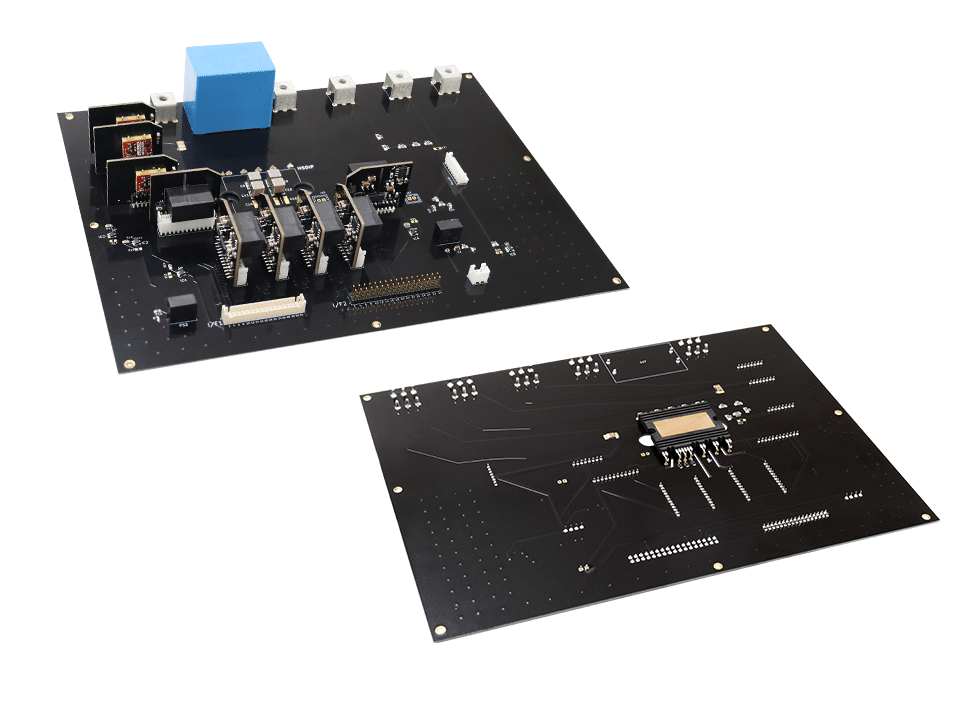
SiC Inverter Reference Design Simplified
It offers engineers a ready-to-use three-phase inverter platform, accelerating prototyping and evaluation of high-efficiency SiC-based power systems.
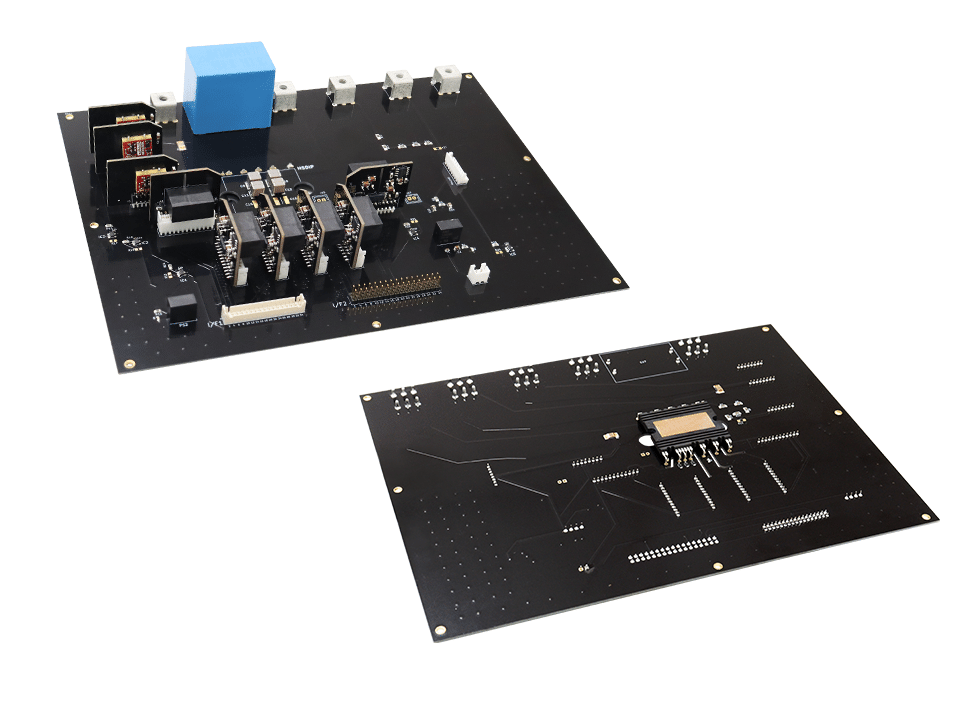
ROHM Semiconductor’s reference deign is particularly useful for power electronics engineers working on high-efficiency motor drives, EV powertrains, and industrial inverter systems. By providing a ready-to-evaluate three-phase inverter platform, it significantly reduces design complexity and shortens development cycles. Engineers can directly access schematics, bill of materials (BOM), PCB layouts, and simulation tools, enabling faster prototyping and validation without building systems from scratch. This makes it valuable for both early-stage feasibility studies and system-level optimization, especially when working with emerging silicon carbide (SiC) technologies.
The design REF68005 is built as a kW-class three-phase inverter evaluation kit based on ROHM’s EcoSiC power modules, specifically the HSDIP20 package. It supports input voltages ranging from 400V to 600V DC and delivers output currents up to 14 Arms, with switching frequencies around 70 kHz. The system operates with a 12V drive supply and accepts 0–5V control signals, making it compatible with standard control platforms used in industrial and automotive applications. This configuration allows engineers to evaluate real-world inverter performance under practical operating conditions, including efficiency, thermal behavior, and switching characteristics.
– Advertisement –

At the core of the design is the BST70T2P4K01-VC, a 1200V, 70A SiC MOSFET-based three-phase bridge module. It integrates multiple power devices into a compact package, enabling high power density and efficient thermal management. The HSDIP20 package incorporates an insulated substrate with high thermal conductivity, allowing improved heat dissipation and reduced temperature rise during high-power operation. Compared to discrete implementations, this approach reduces mounting area and simplifies layout, while supporting faster switching and lower losses—key advantages for modern inverter designs.
The reference design also integrates critical supporting components such as the BM61M41RFV-C gate driver for reliable high-speed switching, PSR100KTQFH1L00 for precise current sensing, and LMR1802G-LB for signal conditioning. Together, these components form a complete inverter subsystem, allowing engineers to study interactions between power stages, sensing circuits, and control loops.
Additionally, ROHM provides comprehensive design resources, including user guides, quick-start documentation, and simulation support via its solution simulator. These tools enable engineers to perform component-level selection, circuit verification, and system-level analysis before hardware implementation. The reference platform is also part of a broader portfolio supporting applications up to hundreds of kilowatts, making it suitable for scaling across automotive and industrial use cases.
Overall, it serves as a practical development platform that bridges the gap between component-level innovation and system-level deployment, enabling faster adoption of SiC-based inverter technologies in next-generation power electronics. For more information, click here.