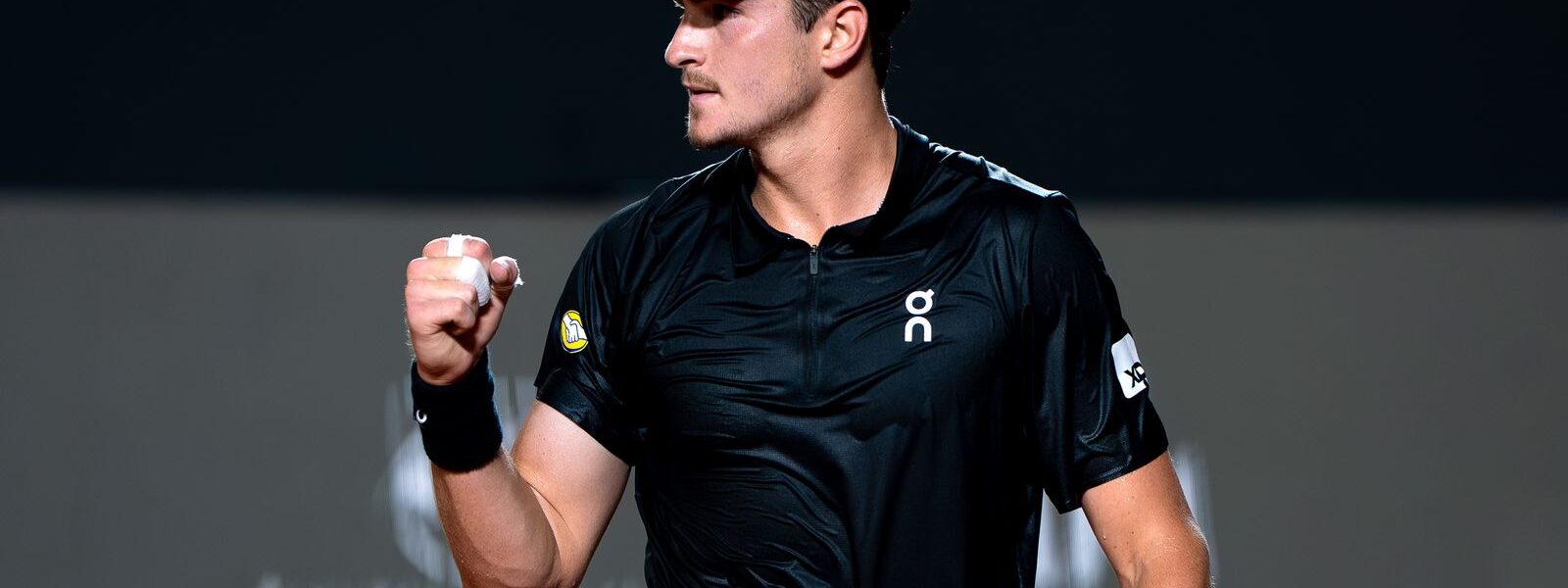

In a boardroom at Miami Gardens’ Hard Rock Stadium earlier this week, Joao Fonseca—the 19-year-old Brazilian tennis phenom—is making media rounds before the Miami Open begins. He’s dressed casually, wearing a bluish On T-shirt, a Whoop fitness band, and a Rolex with a fluted bezel.
For one social media hit, he tries to balance a banana on the top rail of a room divider with the help of an Inspector Gadget-like arm. (Spoiler alert: It does not work.) Next, he’s asked to name the ten youngest 1000-level men’s tournament winners in history—a tough query for even an avid tennis fan. After that, he’s asked about films, and while Fonseca does not have a ton of time to watch movies, he did catch the Oscar-nominated The Secret Agent, directed by the Recife-born Kleber Mendonça Filho and starring Salvador-raised Wagner Moura, both of them fellow Brazilians.
While such content may be a requirement (and sometimes scourge) of our era, what really stands out, as I shadow Fonseca, is just how much presence he has: As we walk through the room, the reporters and creators and staffers we pass all lock in, eyes gliding to follow us. Fonseca and his team cannot get to everyone, of course, yet everyone wants to get to him. The athlete himself also has a confident gait—still lanky and long-limbed in that teenage way, but assured. After two years on tour—with his profile and ranking skyrocketing in the last 12 months—Fonseca seems to have both leveled up and settled in.
“I think I’m understanding a little bit more about how the top players play—not technically, but mentally,” he says as we walk. “How to deal with important points, how to open a match. I’m starting to understand more tricks of the game.”

Photo: Guillaume Ketterer
Understanding—and upgrading—were on full view in Fonseca’s round of 16 match at the BNP Paribas Open in Indian Wells, California a few weeks ago. There, for the first time in his career, he played world number-two Jannik Sinner, fighting through both sets to tiebreaks (and garnishing three set points in the first). Amplified by the dazzle camouflage of his On gear and his signature nuclear forehands, Fonseca looked to be a true threat to Sinner’s dominance (and, by proxy, Carlos Alcaraz’s: Over the past three years, Sinner and Alcaraz have become tennis’s most impermeable duo).
“I knew there wasn’t much of a weakness that I could try to put my power against,” says Fonseca of that crucial match. “I knew that if I went hard, it was going to come back hard as well, so I think one of the biggest things [for me when I play Jannik] is to keep consistency at the highest level. He just doesn’t miss the ball.”

Photo: Nick Remsen
While there’s been endless speculation in the tennis world about his potential rise to challenge Sinner and Alcaraz, Fonseca simply believes in himself. After breaking through last year at both the Australian and Miami Opens, he won two tour titles later in the season—and while not currently at his career ranking peak due to a lower back injury a few months ago, if Indian Wells was any indication, he’s now back in form and better than ever.