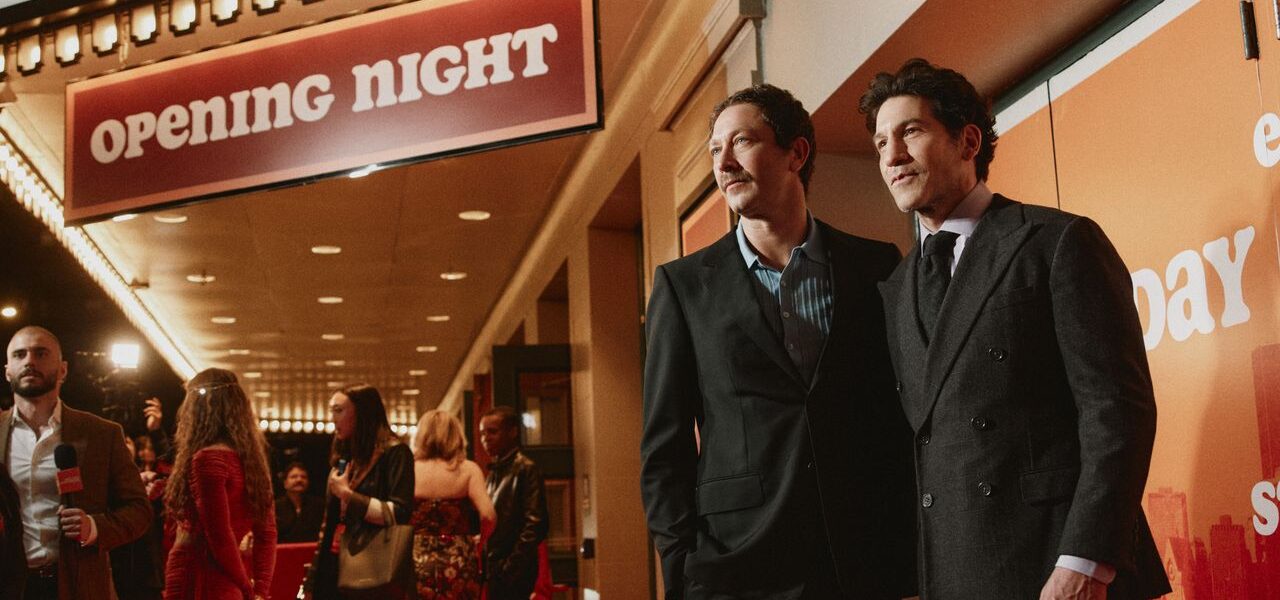

It’s a sweltering day in August of 1972 when Sonny (Jon Bernthal) and Sal (Ebon Moss-Bachrach) decide to rob the Chase Manhattan Bank in Gravesend. Their story is the subject of Dog Day Afternoon—adapted from the 1975 Sidney Lumet film, itself based on a real-life bungled bank robbery—which opened on Broadway on Monday night to a packed and enthusiastic theater.
On one of the first days in New York that truly felt like spring, theatergoers lined up outside of the August Wilson. Some engaged in a sort of ’70s-era method dressing, swishing past in chevron Missoni dresses. NYPD officers were on the scene to monitor the traffic flow—though not nearly as many as the film boasts—as were the likes of Ramy Youssef, Matty Matheson, Don Cheadle, Michael Urie, and Juliana Canfield.
This show, written by decorated playwright Stephen Adly Guirgis, marks the Broadway debuts of both Bernthal and Moss-Bachrach, the pair of whom already have a working relationship from their roles on FX’s The Bear. Guirgis, who was adapting this work from the Oscar-winning screenplay by Frank Pierson, reportedly pulled all-nighters during previews to make final tweaks to this script—and despite the reported off-stage tensions, the drama of the night remained solely on stage.
Guirgis’s adaptation is largely faithful to the film, and in some instances even more faithful to the real-life events than the film was. Though missing some of the profuse shvitzing that made the onscreen standoff feel so excruciating, the icebox of a theater still allows the characters to run hot emotionally (and vocally), demonstrating just how unprepared Sonny and Sal are to pull off a high-stakes crime.
In this version of the story, Sonny’s motivations remain unclear through the first act. He is the director and the showman of the operation, while Sal is the poorly socialized but sympathetic sidekick whose tendencies waver between the homicidal and suicidal. Bernthal, who wears a white V-neck T-shirt and his emotions on his sleeve, has mastered an acting technique in which the severity of his temper can be measured by the throbbing of his neck muscles. He’s also not afraid to curse like a sailor.
“This is Brooklyn, Colleen,” Sonny reminds the head bank teller in the branch (played by Jessica Hecht) after she requests that he tone down his language, “not Mister Rogers’s Neighborhood.”
It is only in the second act, when the media outs the criminal duo as “avowed homosexuals,” that we come to learn about Sonny’s wife, Leon, a transgender woman for whom Sonny is committing this crime. He intends to use the funds not for personal gain, but rather to pay for Leon’s gender-affirming surgery. Moss-Bachrach, who delivers a controlled but emotive performance, has little interest in being called names by the media and defensively blurts, “I ain’t no homosexual, Sonny!”
Like the film—which was deemed ahead of its time for Al Pacino’s portrayal of a queer man and the inclusion of a transgender character—this adaptation seems interested in the political implications of both queerness and police brutality. The topicality of such issues hasn’t lessened in the intervening five decades, and in one notable instance, mirroring a scene from the movie, Bernthal begins shouting “Attica!”—referencing the 1971 prison uprising in which 43 people died—and much of the 2026 audience joins in.
After the actors take their bows to an audience on its feet, the celebration moves downtown to a spacious event venue called Second, where guests enjoy glasses of wine and slices of Sicilian-style pizza—an on-theme snack, given Sonny’s demand for pizza in the original film. Dum-Dums lollipops, a signature banking treat, are also plentiful, stored in little baskets at every table.
One of the windows looks out onto a courtyard, and on the building across the way a video of co-stars Bernthal and Moss-Bachrach is projected. In this silent, grainy short, they appear in period garb, roaming the streets of New York in what is meant to be the 1970s. Even without sound, they ooze the electric chemistry of partners in crime—ones you might even root for in a bank robbery.