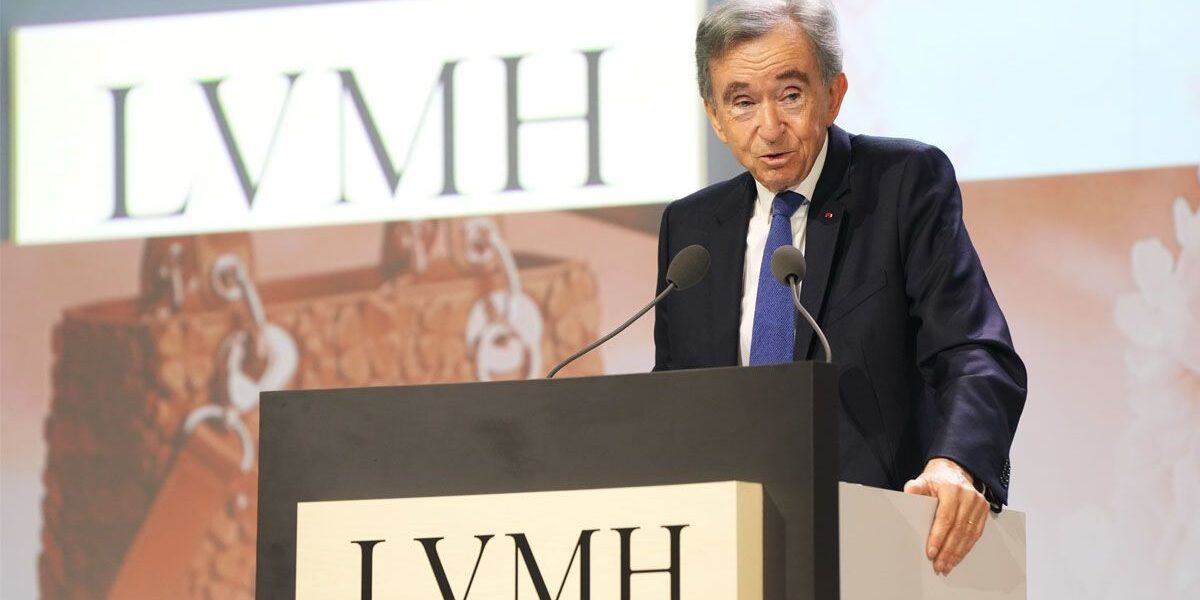

“Imagination is more important than knowledge,” LVMH chair and CEO Bernard Arnault said on Thursday, quoting Einstein at the group’s annual general meeting, while sporting a Louis Vuitton Tambour Einstein watch. Held at the Carrousel du Louvre in Paris, Arnault addressed key topics including the impact of the Middle East crisis, the reception of Jonathan Anderson’s first collections at Dior, and the CEO’s succession plan.
During the meeting, Arnault dismissed speculations about a sale of Paris department store La Samaritaine, which LVMH reopened in 2021 after 16 years of renovation and whose footfall has been lower than expected. “Of course, we want to keep it. It’s an extraordinary asset and we’ll make it work,” he said. “With [Le Bon Marché chair and CEO, who is also leading La Samaritaine] Patrice Wagner and his team, I’m sure we’re going to achieve something amazing.”
The timing of the general meeting coincided with LVMH’s share price dropping around 25% since the beginning of the year. The world’s largest luxury conglomerate — which generated €80.8 billion in sales in 2025, down from €84.7 billion in 2024 — is not immune to the wider luxury downturn, or global uncertainties. In Q1 2026, LVMH sales were up 1%, while fashion and leather goods sales were down 2%. But Arnault reiterated his confidence in the luxury sector — and in his five children, who each spoke in turn about their respective fields: Jean, watch director of Louis Vuitton; Frédéric, CEO of Loro Piana; Alexandre, deputy CEO of Moët Hennessy; Delphine, chair and CEO of Christian Dior Couture; and Antoine, LVMH director of image and environment.
The chief executive seemed in good spirits, telling a 25-year-old shareholder “congratulations for buying shares. It’s a good time. I do it too, each at our own scale.” The Arnault family raised its stake in LVMH to over 50% of the group’s share capital earlier this year.
Here are the key takeaways.
“Everything depends on how the Middle East crisis unfolds”
The luxury sector is feeling the impact of the conflict in the Middle East. Despite variation between companies, the war has reduced luxury revenue growth by around 1 to 2 percentage points in the first quarter. LVMH reported that the ongoing conflict reduced organic growth for the conglomerate by approximately 1% in Q1.
“This crisis has reduced the first-quarter growth we expected by half,” Arnault noted. “In the short term, everything depends on how this crisis unfolds,” Arnault told shareholders “It could turn into a global catastrophe with extremely serious and very negative economic consequences — in which case, who can say how 2026 will play out? Or it might be resolved one way or another more quickly, which is what we all hope for, even if it doesn’t seem easy; and in that case, business will gradually return to normal. It’s quite unpredictable.”
He continued: “If the second scenario comes to pass, I believe the year will show a revival of growth across our various activities. Otherwise, we will have to face a crisis. We’ve been through that before, and it’s very likely that we will once again gain market share, as we did in 2025.”
Arnault was also asked to share his view on the Chinese market, where luxury brands have been facing muted consumer demand amid economic uncertainty, rising price sensitivity, and growing preference for domestic labels.
“China is a very important market for us,” Arnault said. “It’s a market where customers are becoming increasingly familiar with the products and more demanding. As a result, it’s an excellent market for the LVMH group, because a few years ago it was easy to go into China, put a brand on a product, and sell it — no matter what, it worked. That is no longer the case. Today, you need to deliver quality, heritage, the right locations and the right teams, and all of that requires significant effort. It is the second largest market after the US, so I remain confident and not overly concerned about the evolution of this market, for which the prospects remain strong for our group.”