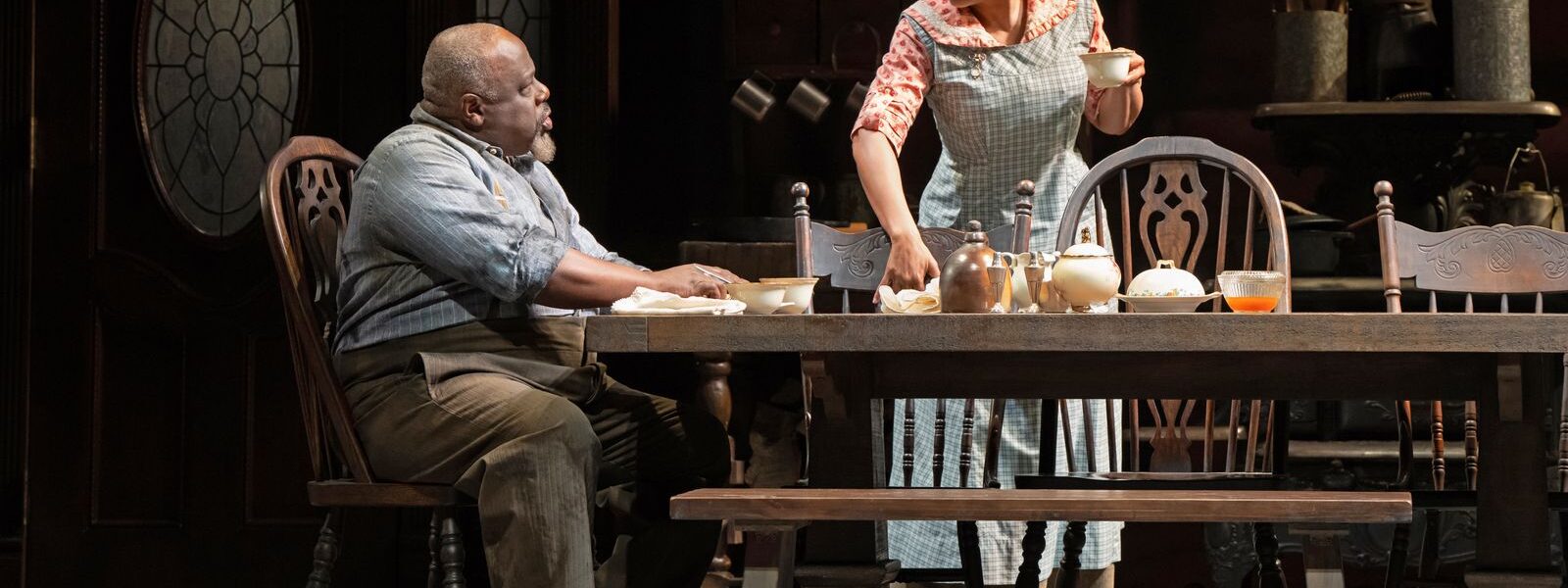

When Taraji P. Henson first appears onstage in the 2026 revival of Joe Turner’s Come and Gone, she’s met with lengthy, rapturous applause. It delights her every time.
“It moves me to tears,” Henson says. “It’s just so overwhelming because this is not a movie theater. Broadway is a destination. It’s not, ‘Oh, I’m gonna go to the AMC in Sherman Oaks’ or, ‘I’m gonna meet my girls at the AMC in Beverly Hills.’ You have to come to New York. And people are coming—they’re flying, they’re traveling in buses, they’re caravanning to see little old me, this girl from southeast D.C. who just had a dream.”
At the Ethel Barrymore Theatre, Henson is making her Broadway debut as Bertha Holly, a woman running a cozy Pittsburgh boardinghouse with her husband, Seth (Cedric the Entertainer), in 1911, during the Great Migration. There, lost souls like the mysterious Herald Loomis (Joshua Boone) seek refuge and reckon with their complicated pasts.
Henson describes Bertha as “the glue” of the operation: Though she doesn’t have any children, she’s a devoted maternal figure to her boarders, doing everything in her power to make them feel at home—whether that’s by making them soulful home-cooked meals or lending a nonjudgmental listening ear.
“Bertha is the moral compass and the North Star,” Henson says. “She talks about love and laughter during a very dark time. The Great Migration was full of hope, but a lot of people didn’t make it. It wasn’t easy coming up north. People were searching for lost family members, reconnecting with their spirituality and identity, and trying to find some sense of freedom. A lot was going on, but when you come to the Holly house, you’re gonna get fed. You’re gonna get loved on.”

The role arrived at just the right time. Debbie Allen, the play’s director, called Henson, “and I said yes right away.” She’d been approached about Broadway roles before—among them, Shug Avery in The Color Purple—but other projects had always stood in the way. “I was either on Empire or doing a movie,” she explains. “So this time, it was perfect. That’s why I think the play found me. In some way, spiritually, I feel like I was supposed to do it.”
In fact, Henson has adjusted rather quickly to the rhythms and the rigors of performing live. “If you’re emoting on the stage or you tell a joke, you know right away if the audience feels it. In film, you have to wait until they yell cut, so it’s a delayed reaction. And you also have no control. You can put fire in the can, baby, but then they can go into the editing room and chop and screw your performance. But when I’m on that stage? Ain’t no editor.”