“When Fashion Stays in Its Own Bubble, It’s Not Responding To The World”: Iris van Herpen Gets a Retrospective in Brooklyn

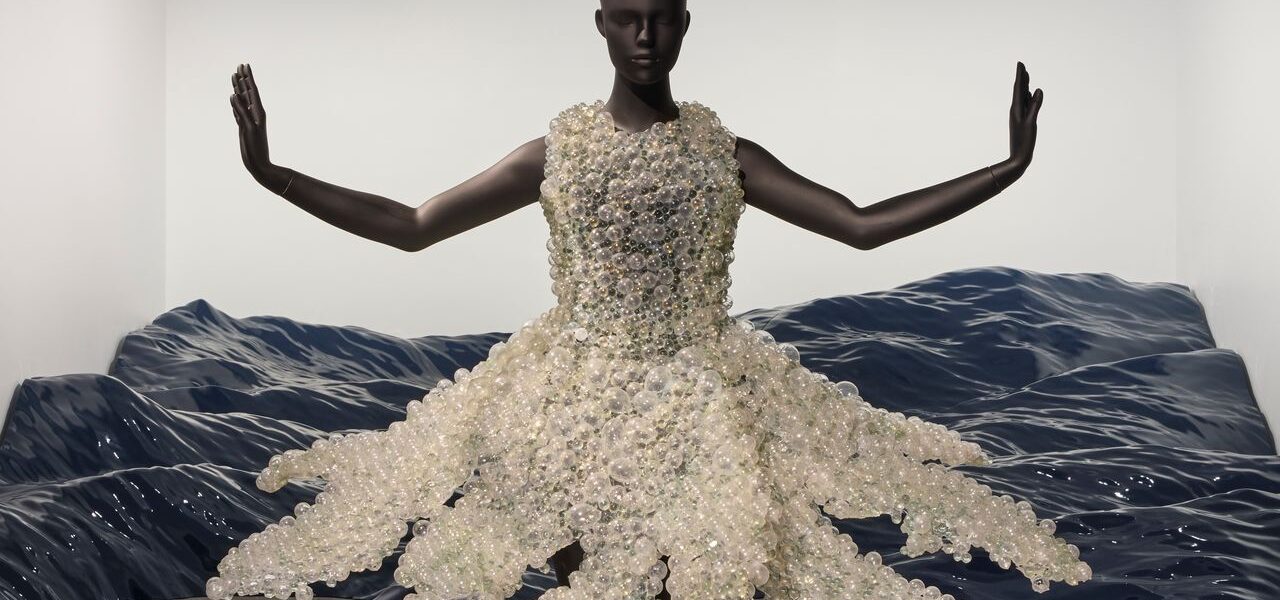
The first piece visitors encounter upon entering Iris van Herpen’s new exhibition at the Brooklyn Museum in New York is the designer’s 2016 bubble dress, a precursor to the 2026 iteration, which also emitted blown bubbles, that went viral when Eileen Gu wore it to the Met Gala last week.
Opening on May 16, “Iris van Herpen: Sculpting the Senses” iterates on, but does not exactly replicate, the original show in Paris, which was organized by Cloé Pitiot and Louise Curtis of the Musée des Arts Décoratifs in 2023. Working in concert with the designer from New York is Matthew Yokobosky, senior curator of fashion and material culture, Brooklyn Museum, and Imani Williford, who have adapted the show—van Herpen’s first big splash stateside—to fit their environs. Yokobosky calls it a mid-career retrospective as this month marks van Herpen’s 19th year in business.
Almost two decades in, the designer remains sui generis. Van Herpen is one of the few to convincingly and organically introduce technology to couture, showing how uniqueness can be achieved through 3D printing. And she has channeled the forces of nature, creating mycelium lace and, most recently, a living dress made of 125 million bioluminescent algae. This luminous wonder has made the trip to Brooklyn, where it is encased in glass, and is regularly refreshed with mist.
Van Herpen comes at fashion somewhat sideways, having been a dancer for years before she attended the ArtEZ University of the Arts in the Netherlands, and which may explain her reverence for the body. Eschewing the usual star system—and with scientists, artists, and architects in her orbit—van Herpen’s practice is extremely collaborative; many of the pieces in the collections are co-credited. In these partnerships, aesthetics are only a part of the equation, as the focus is often on material development, technical advancement, and, believe it or not, functionality. “Of course, you see a lot of collaborations in fashion that are marketing driven,” said van Herpen on a recent walkthrough of the show. “But I think here there are collaborations that try to get fashion to find new materials, find new ways of making, but also to bring in sustainability to try to change the way we work.”
“I love the collaborations that I’m having because for me the process is even more important than the end results, and the process is really an ongoing research,” she said. “It’s shaping me, it’s forming me, and, by working with people from other disciplines, you really share knowledge. [When] fashion stays within its own bubble, it’s not responding to the world. I think this exhibition is to really show the interproductiveness between philosophy, science, fashion, and art, of course.”
Visitors’ immersion into van Herpen’s world takes place within 11 themed sections. If the Met’s “Costume Art” examines the topography of the body and its organs, “Sculpting the Senses” drills down much deeper, to the molecular level, and not just of people, but of the natural world as well. The choreography of the exhibition is well done, as it travels from micro to macro, and, as Yakobosky notes, starts with the blue of water and ends with the blue of the cosmos. Along the way, he added, “you start to see relationships between different life forms.” And also between art, nature, and fashion.
In the first half of 2026, an interesting trend has emerged in the form of three exhibitions that directly pair garments and artworks. The Museum at FIT kicked things off with “Art x Fashion,” and now on display in the Met’s new Condé M. Nast Galleries is Andrew Bolton’s “Costume Art,” which opened to the public on May 10. In it, art of all kinds is paired with garments to show the centrality of the dressed body across the museum’s collections. “Iris van Herpen: Sculpting the Senses,” completes the triptych by including artworks, though there are many fewer than at the Met, and they are used to different ends, most often to highlight the incredible materiality of van Herpen’s work and its organic, morphing shapes.