
Is God Is, playwright Aleshea Harris’s epic tale of family trauma and vengeance, is also a story of feminine strength. It was only appropriate, then, that Harris adapt it herself.
“It was baptism by fire,” the Pulitzer Prize finalist says of writing and directing the play’s new film adaptation, out May 15, which happens to both begin and end with conflagrations.
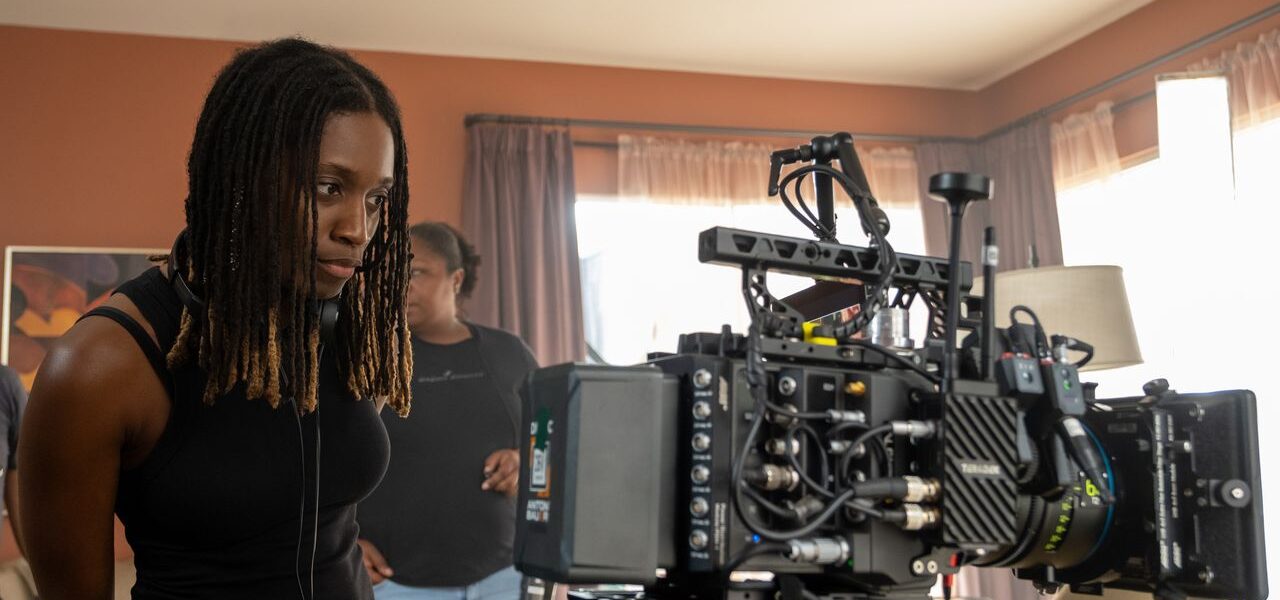
Following twin sisters on a cross-country mission of revenge, Harris’s play premiered Off Broadway in 2018 to critical praise and multiple extensions. It had always been Harris’s plan to turn the work into a screenplay, but it was only at the urging of her friends and colleagues that she stepped behind the camera. “As a playwright, I have really strong ideas, probably to the frustration of some directors I’ve worked with, about how things should be performed,” Harris says. “It’s really because of the women around me, who believed in me, that I was able to do that. By the time we were pitching to the studio, it was kind of a package deal.”
Her female support offscreen reflected the relationships onscreen in Is God Is, which centers on sisters Racine, a.k.a. the Rough One (Kara Young), and Anaia, a.k.a. the Quiet One (Mallori Johnson). Scarred, both physically and mentally, from a brutal attack by their father, the sisters receive a surprise summons from their mother (Vivica A. Fox) to hear her dying request: “Make your daddy dead. Real dead.”
It’s a sudden serving of generational trauma for the women. Growing up in foster care, Racine and Anaia thought they were parentless. But Ruby—or God, as Racine refers to her—was only protecting her children from their father, who had drenched her in alcohol and lit her on fire. (The girls’ scars come from trying to put out the flames.) God’s deathbed request sets them on a road-trip adventure of sweeping proportions as they find themselves battling against one form of patriarchy or another. As Racine tells Anaia, “This is some destiny type shit.”
While writing, Harris knew the sisters had to be twins. “There’s inherent drama, I think, with twins. There’s also something that feels mythic about twins. They feel sort of magical and unusual.” It’s in their long journey into the South—by car, then bus, then on a very long walk—that the fissures in the sisters’ relationship begin to show. Long two codependent halves, they begin to assert themselves as individuals on the road—an idea that Harris delighted in exploring visually.