
It’s not every day that a Vogue Business journalist dons a hard hat and hi-vis vest, but that was my look du jour last week, when I visited Lundhs in Norway, the world’s only extractor of the Norwegian natural stone larvikite. I was there with Oslo-based brand Tom Wood, which recently struck up a partnership with Lundhs to turn the quarry’s waste into high-end jewelry.
Larvikite is traditionally extracted in large slabs, used for facades, monuments, and kitchen countertops. But only 8-10% of what Lundhs extracts get used, with the rest ground down to gravel. Rather than breaking virgin ground, Tom Wood uses a small percentage of Lundhs’s waste to make ornamental stones for its unisex jewelry, part of an effort by Lundhs to find alternative uses for its waste. There are beaded larvikite bracelets and looping larvikite necklaces, dainty larvikite earrings, and a larvikite iteration of the brand’s signature androgynous signet ring. It’s the jewelry equivalent of deadstock, using leftover larvikite that would otherwise be ground down into gravel.

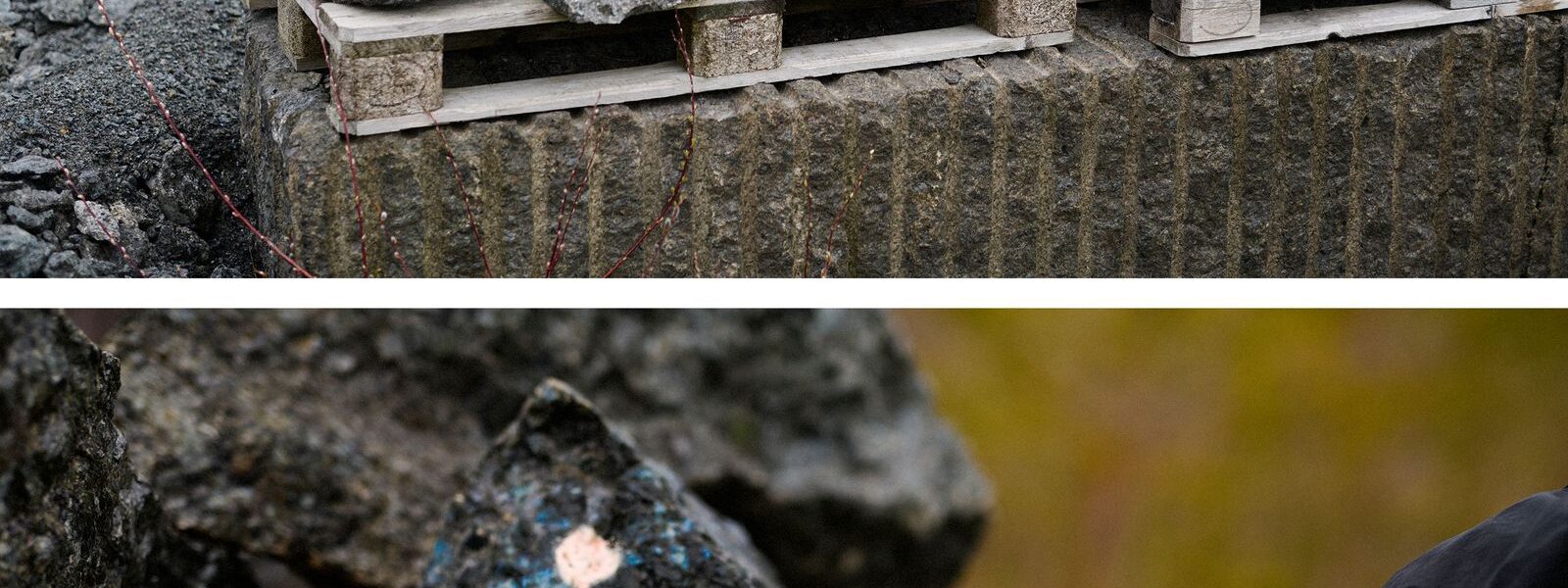
Tom Wood uses larvikite sourced from the Lundhs quarry in Larvik, Norway. Larvikite is the national stone of Norway.
Beyond products, the partnership is part of a broader push for supply chain traceability in a notoriously opaque industry riddled with red flags. Traditional jewelry supply chains are near-impossible to trace. Even the most well-intentioned brands struggle to navigate the swathes of middlemen obscuring the true origin of metals, mined diamonds, and gemstones. But larvikite — the national stone of Norway — can only be found in one place: the Norwegian municipality of Larvik. The dark gray or black stone has shimmering flecks of silver, blue, and green, and is often dubbed ‘Norwegian moonstone’ or ‘blue pearl granite’.
When Tom Wood’s founder and creative director Mona Jensen first tried to source larvikite, she was directed to suppliers in Thailand, which led her further upstream to China, where the suppliers in question claimed that the larvikite came from Norway, but couldn’t trace where it had been in between, or how it ended up there. Actually tracing this supply chain is very costly, she says, which is why Tom Wood now goes direct to the quarry. “There are many levels to transparency and traceability, but for me, it’s about people,” she explains. “It’s about knowing who was involved, how they were treated, what they were paid, and what type of facilities they work in.”

Tom Wood founder and creative director Mona Jensen (left), and her husband Morten Isachsen, the brand’s CEO (right).