David Lindsay-Abaire Risked Enraging His Neighbors With ‘The Balusters.’ It Was Worth It

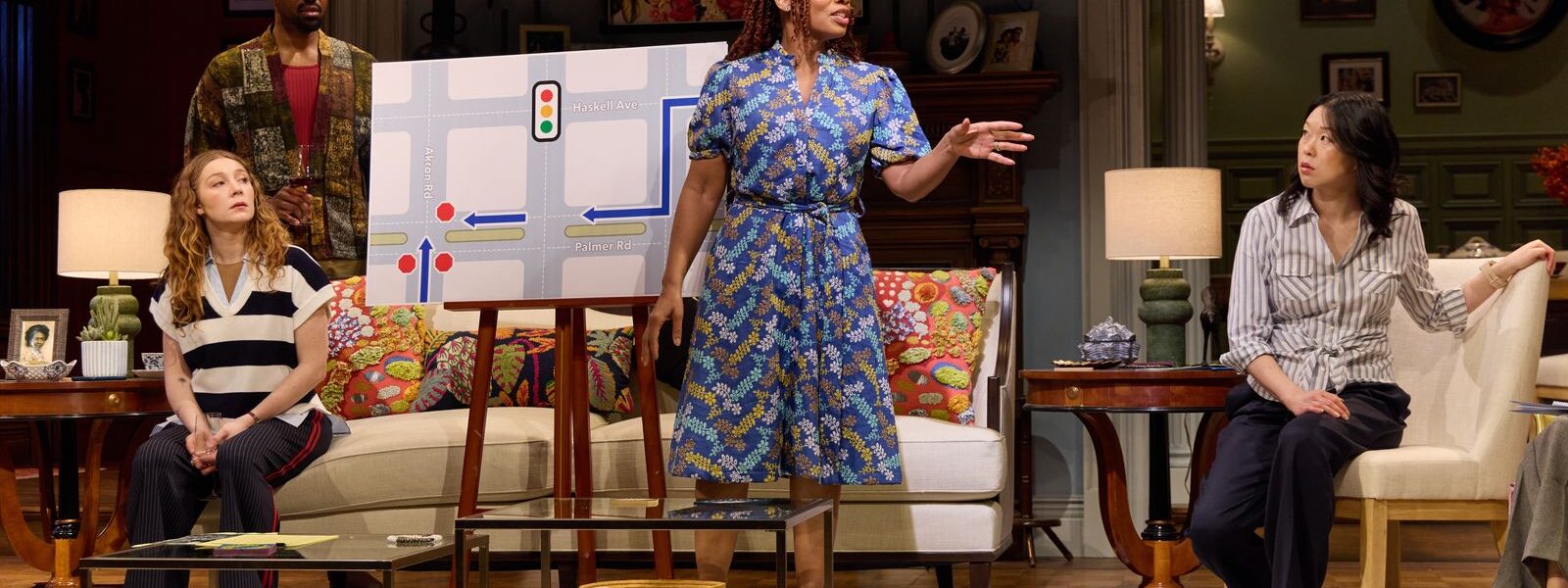
Bring it, The Balusters does. Over the course of four months, the board members squabble over speed humps versus bumps, racial profiling, homophobia, neighborhood surveillance, PETA, nepotism, a baby named Rocket, and—yes—period-inappropriate balusters. Alliances form. “White girl tears” are shed. Identity politics surface and resurface. Faux pas and microaggressions abound.
Lindsay-Abaire is used to writing toward fear—his 2006 drama Rabbit Hole, which he wrote as a new father, centers on child loss—but this play fostered its own breed of anxiety. “Am I scared? Sure, I’m scared…this is 10 people discussing porches,” he says. “But every play that I’ve written scares me in some ways.”
One risk in this case involved writing for so many identities that were not his own. “I was worried about getting them all wrong,” Lindsay-Abaire says. “But because the play was so much about a community, and not just one person on a journey, I felt like my job was to create a fully fleshed-out, dimensional community.” To stay on track—especially when it came to his nonwhite characters, of whom there are several—he did something he rarely does: he shared the script with trusted peers, especially writers of color, throughout the revision process. “They not only gave me permission but encouraged me to make the characters of color as prickly as the white characters,” he says.
“On reading it, there wasn’t one moment where I thought, ‘Oh, she probably wouldn’t say that,’” says Anika Noni Rose, who plays the straight-shooting Vernon Point newcomer Kyra, in whose comfortable living room the play’s action is set. “As a Black woman, with someone from a different space writing for me, you often have a moment where you feel like, Can we talk about this? But we didn’t.”

The rowdy board in the play was inspired by the neighborhood association in Lindsay-Abaire’s own historic district, Brooklyn’s Prospect Park South—of which his wife, Christine, is a member. The playwright sums up their conflicts as “operatic,” and recalls Christine returning from a meeting to recount the fallout over a drainage ditch. “I would think, What is this really about? It can’t possibly be about the drainage ditch,” Lindsay-Abaire says. “Someone is obsessed with something else that’s much deeper in their soul.”