How a 1984 Keith Haring-Graffitied Suitcase Inspired Louis Vuitton’s Resort 2027 Collection

As European businesses look to grow their businesses stateside, New York is back in fashion—in addition to Vuitton, Gucci just showed its resort collection in Times Square. Haring, who was born in Pennsylvania, was, along with his friend Jean-Michel Basquiat, a quintessential downtown artist of the 1980s. Some of his earliest works were chalk drawings done in the subway and other public places. He believed art was for the people. Speaking with Nicole Phelps, Ghesquière revealed some of the dichotomies he was thinking about for resort. One was the city’s uptown-downtown divide, which was still in place in the ’80s, a decade that the French designer returns to over and over again, as he does with sci-fi. (Note his use of Haring’s UFO drawing.)
There was also some time-traveling going on. Ghesquière was interested in exploring the Gilded Age, the period during which Henry Clay Frick made his fortune, much of which he spent on collecting art, from Old Masters to practitioners of the Aesthetic Movement, which he displayed in his Fifth Avenue abode. “”It was Frick’s custom to have an organist in on Saturday afternoons to fill the gallery of his mansion . . . with the majestic strains of ‘The Rosary’ and ‘Silver Threads Among the Gold’ while he himself sat on a Renaissance throne, under a baldachin, and every now and then looked up from his Saturday Evening Post to contemplate the works of Rembrandt… or Boucher. . . .” recounted Joseph Duveen, from whom Frick acquired many masterpieces, in Vogue. Into this rarified setting, Ghesquière introduced the graphic, kinetic, street-centric work of Haring to a soundtrack of Peaches, a darling of the aughts electroclash music scene.
At the same time that the special appearance of the suitcase helps advance Ghesquière’s narrative, it also brings together the concept of heritage with the physicality and material record of the past. It also showed the scarcity principle—which posits that desire increases in proportion to exclusivity (and which partly explains fashion’s fascination for vintage)—in action.


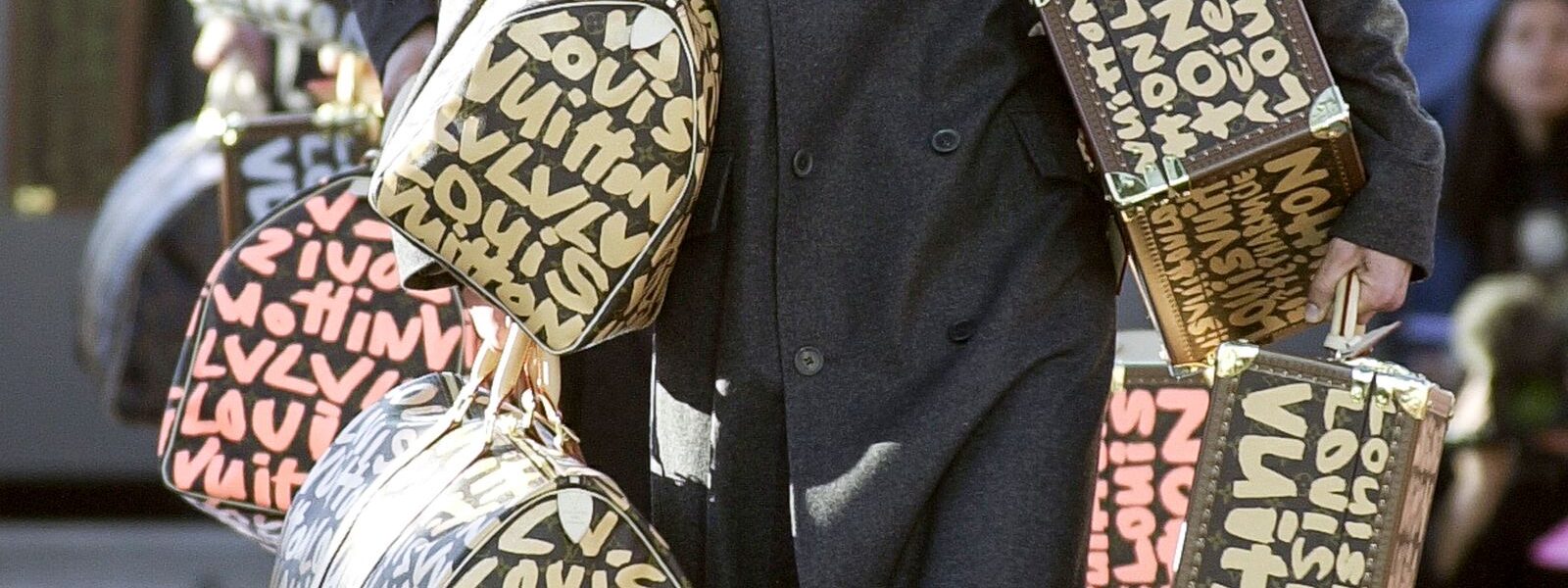
The tie-in to graffiti is especially interesting within the context of this French house, which was founded in 1854 as a leather goods company. Just short of 150 years later, in 1997, Marc Jacobs, an American, was tapped to expand the company’s offerings to include ready-to-wear. His first artist collaboration—one which was astoundingly successful and which set a template that’s still being used today—dates to 2001 when he asked artist and designer Stephen Sprouse to tag the LV logo canvas. (This successful venture was followed by many more with the likes of Takashi Murakami, Julie Verhouven, Richard Prince, and more.) Adding to the intrigue, Sprouse’s fall 1998 collection, titled Signature, was a collaboration with Haring.