
Words and photographs by Mustafah Abdulaziz
“In 2012, I began “Water” — a photographic series on the transformation of global landscapes under the strain of water scarcity. Prompted by a UN statistic that half the world’s population may face scarcity by 2030, I am interested in people who struggle to act upon their environment as much as they are shaped by it. Structured into chapters, the project has covered cholera outbreaks in Sierra Leone, gender issues and water access across Ethiopia, Pakistan, and Nigeria, the deforestation of the Amazon, industrialization on the Yangtze River in China, spirituality and pollution on the Ganges River of India, and the scale of storms along the coasts of Iceland and Cornwall. The scope of the project has documented the legacy of hurricanes in the American Gulf in Texas, Louisiana, and Florida, as well as the dual droughts in California, one of the largest economies of the world, and the historic drought of Cape Town, South Africa, that nearly resulted in the first 21st Century City to run out of water. In my adopted country of Germany I documented the floods of 2021 in Rhineland-Palatinate and North Rhine-Westphalia before embarking on a year-long examination of climate change in the Arctic nations of Greenland, Canada, Norway, Sweden, and the United States. The project examines our choices, collectively and globally, and how they impact the lives of people who inhabit systems under stress. Water is the mirror and in the landscape our behavior is revealed.”

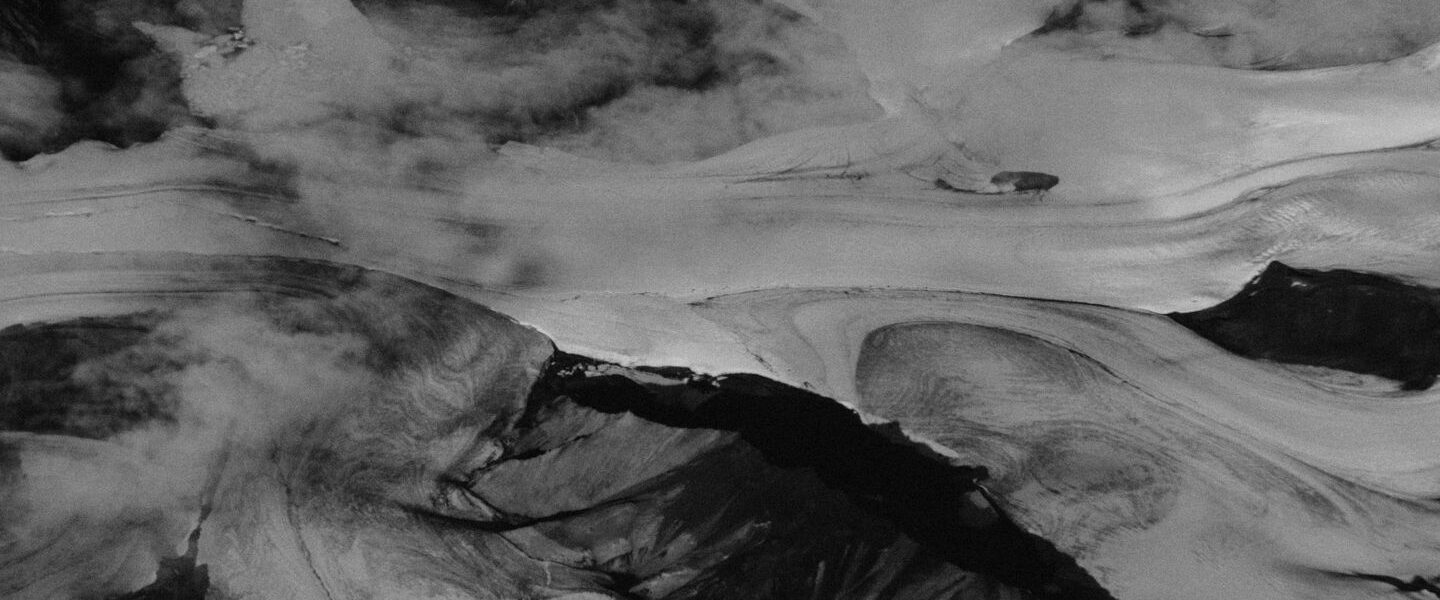
Baffin Bay, Canada, 2022
“It is towards this Far North that the American photographer Mustafah Abdulaziz, based in Berlin, turned his lens. For ten years, he has documented the impact of climate change on human beings. He has worked extensively on the theme of water, an increasingly rare resource in Asia, Africa, and the United States. e Arctic represents a new step in its hunt for a world on the path to self-destruction.””In 2022, he visited Greenland, the Norwegian archipelago of Svalbard, Alaska, northern Canada, and Kiruna, the most important city in Swedish Lapland. He came back with photos whose aesthetic recalls the world of fantasy—that of the tales – a mixture of black and white and colors. As if to recall what was and is no longer or perhaps never was, except in our imagination which continues to fantasize about wild spaces far from all civilization. In his photos, there are no polar bears, northern lights, or snow-capped mountains. But the ice floe, red with the blood of a seal killed by a Greenlandic hunter. In Ilulissat, Greenland, Mustafah Abdulaziz photographs the port, cluttered with trawlers, the docks, covered with boxes of fish – overfished halibut – which will be transported to the other side of the world. In Alaska, he flies over the Red Dog open pit mine, which exploits the largest zinc reserves in the world. It also pollutes more than any other industrial facility in North America. It shows the greenish water of the lake in the heart of the mountain dug by man. In Kiruna, 200 kilometers north of the Arctic Circle, where the ground threatens to collapse, eaten away by the iron mine in which the Swedish group LKAB has just discovered an immense deposit of rare earth metals, he goes to meet the residents moving the entire city.”— “Horreur Boréale” by Anne-Françoise Hivert. Numéro 632, Le Monde M Magazine (Paris)

Record-low summer sea ice. Arctic Ocean, 2022In previous times, miners took a caged canary when they went underground. If the bird stopped singing, the men knew they had to get to the surface as quickly as possible. Toxic gas was circulating in the mine. e Arctic is today this canary, which alerts humanity to the state of the planet. Nowhere else do temperatures rise so quickly. Over the past forty years, warming has been four times faster than in the rest of the world. It’s only the beginning. In the coming decades, the phenomenon is expected to accelerate. e reason for this is the mechanism of Arctic amplification: in a warming global climate, the sea ice and snow are losing ground and thus reflect less of the sun’s rays, the heat of which is then absorbed by the sea. All scientific studies are clear: by the 2030s, the Arctic could be deprived of sea ice in summer.