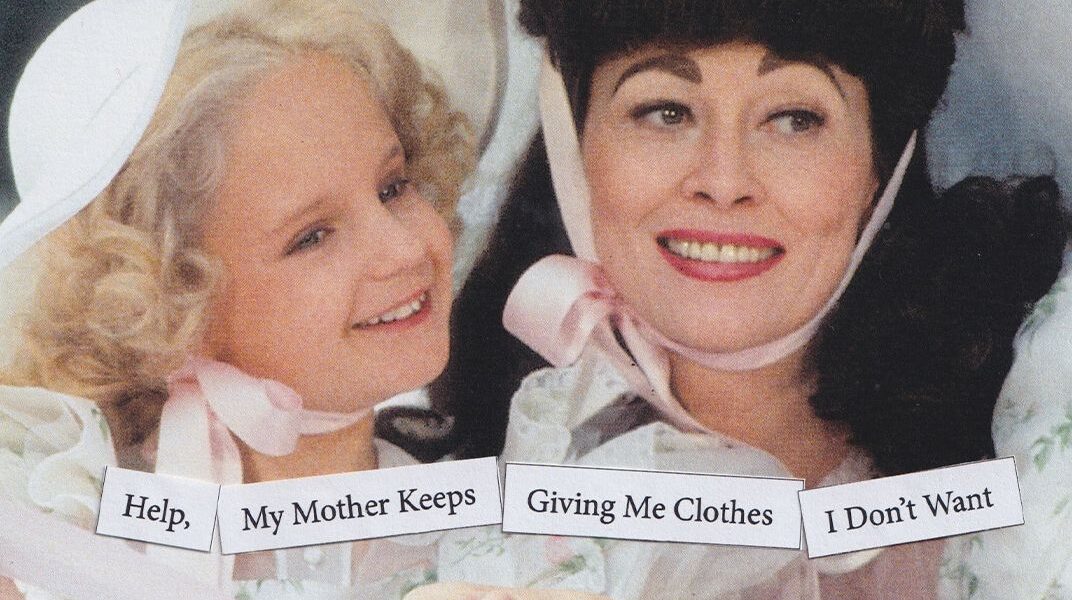

I feel the urge to keep anything–and everything–my mother gives me. Hell, I keep her grocery lists, which she scrawls on notecards (tuna, lettuce, coconut water) and signs with a signature lipstick blot. But her old clothes are the real problem: Consignment store sweaters full of moth holes. A pair of Harley Davidson leather boots that gnawed the backs of my ankles the last time I wore them 10 years ago. The hardcore ankle boots are now dehydrated and crumpled. All of it marinates in the back of my closet.
I bring this up on the eve of Mother’s Day, but this hoarding syndrome doesn’t solely apply to mom castoffs. It can happen with anyone we’re related to or with whom we feel close. Who hasn’t received a sweater that they’ll never wear? We stuff it in a drawer and forget about it until the giver asks why we haven’t worn it. The guilt swells and swells while the sweater sits and sits. It’s a vicious circle. Retail or hand-me-down, these unwanted gifts take up not just physical but emotional space as well.
Being a good (neurotic) daughter, I contacted a professional for help. Psychologist Carolyn Mair, the author of The Psychology of Fashion, told me that our guilt in these situations doesn’t necessarily have to do with whether we like a gifted garment, but what it signifies. “When a mother passes something down, she’s offering more than fabric; she’s offering continuity, a tangible link between her identity and yours,” she said. “That’s why refusal can feel emotionally loaded and hurtful to her, and why discarding it later can stir a daughter or son’s guilt that feels out of proportion.”
When we say au revoir to those three pashminas our mom threw at us the last time we were home, are we telling her that we don’t care about her? I buzzed my fashion fairy godmother from across the pond, fellow writer Plum Sykes, who is the mother of two teenage girls, to get her opinion. Sykes (who is definitively not the real Emily) recounted a harrowing story of trying to dump some Nina Ricci on her university-aged child. “Chiffon dress, pale cream, absolutely beautiful. And I said to Ursula on Sunday, ‘Usy, do you want to take this back to Paris with you to art school?” She said she needed a summer dress. And she went, ‘It’s a bit Y2K, mom.’”
Quelle horreur! Was Sykes hurt by her daughter’s Ricci-rejection? “Well, I don’t want the bloody Y2K thing either, which is why I’m trying to get rid of it!” Plum didn’t like the item anyway, and it just so happened that her daughter was the closest thing to a charity shop.
My friend, the writer Nicolaia Rips, has a name for this phenomenon; she calls the daughter-deposit move a “soft trashcan.” Little did Plum know that merely offering her early ’00s chiffon could leave a lasting mark on teenage Urusla. “These items take on symbolic weight, becoming vessels for memory and attachment. This is psychological essentialism,” says Mair. “What makes it irreplaceable is the essence: the fact that the item was worn by the mother. This matters more than the item itself.”
Dear readers, this situation calls for a bit of boundary-setting; it’s time to learn the art of refusal. First, understand where the beloved person’s offloading is coming from. Is the gift a crocheted scarf made by your great-grandmother, the yarn sourced from a goat she raised herself, then smuggled out of the old country, and passed down through the family for decades? Or is it a sack of ripped and torn J. Brand jeans that your mom simply doesn’t want to give to Goodwill? It is up to you to decipher the matriarchal “dump.”